Is the Montgomery County DA Violating the Due Process Rights of Arrestees by Tweeting Their Names?
I blogged a month or so ago about plans by the Montgomery County DA's office to tweet the names of DUI arrestees. (h/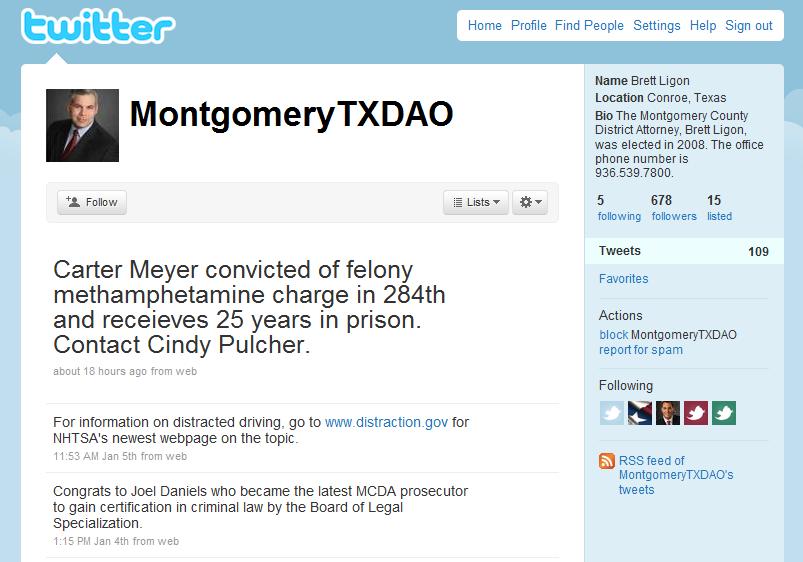 t Paul Kennedy "Drink. Drive. Tweet.") I speculated as to whether this raised any ethical issues and overall it just struck me as a bad idea. It turns out this may actually violate the rights of those who are arrested and whose names are tweeted.
Someone successfully challenged a similar practice in New York: Bursac v. Suozzi, 22 Misc.3d 328, 868 N.Y.S.2d 470 (Supreme Court, Nassau County New York 2008). In Bursac, the Nassau County Executive created a wall of shame, on which it posted a photo of people who were arrested for DUIs. Postings were accompanied by press releases. One arrestee (against whom charges were dismissed) requested that the posting be removed and when this request was refused, sued. The court found that the posting violated the petitioner's due process rights:
BTW: my earlier post was picked up by a few media outlets, including IDG News ("Texas County to Name Drunk Drivers on Twitter") and Mashable ("Drunk Drivers in Texas to be Named on Twitter"). Of course, my all time favorite was a piece which contained this *somewhat* inaccurate description:
t Paul Kennedy "Drink. Drive. Tweet.") I speculated as to whether this raised any ethical issues and overall it just struck me as a bad idea. It turns out this may actually violate the rights of those who are arrested and whose names are tweeted. The decision is summarized at Cyb3rcrim3 here: "Stigma Plus." (An excellent blog that I recently started reading.) As Professor Brenner notes at her blog, the County Executive relied on Paul v. Davis, 424 U.S. 693 (1976). in Davis, the Court held that the Louisville police department's creation of a pamphlet containing the names of individuals recently arrested for shoplifting could not be challenged under section 1983:[the County Executive's actions,] in publishing and maintaining the petitioner's name, picture and identifying information embedded in a press release on the County's Internet website, which results in limitless and eternal notoriety, without any controls, is sufficient to be the `plus’ in the `stigma plus’ due process analysis in the case at bar. The Court finds that the petitioner's due process rights have been violated.
From my read of the Court's opinion in Davis, tarnishment of reputation alone is not sufficient to implicate the Due Process Clause - the state has to somehow interfere with a person's right to employment or take away something in which you have a property interest. Notwithstanding Davis, the court in Bursac found the publication of identifying information about DUI arrestees to be problematic because of the unique nature of the internet, and the fact that landlords, employers, and others screen people through internet searches. (Davis seemed to say that the government had to be the one depriving you of a job or other benefit, but Bursac didn't delve into this distinction. Also, maybe there are other cases out there on this issue, I haven't done an exhaustive search.) In the court's eyes, by labeling someone as a DUI arrestee on the internet, you may as well be denying them a job opportunity:reputation alone does not implicate any 'liberty' or 'property' interest sufficient to invoke the protection of the due process clause.
There you have it. Regardless of whether Bursac is correct, it certainly seems like the Montgomery County arrestees have a colorable case. Another potentially distinguishing aspect of the Montgomery County scheme (from the one in Davis) is that the DA's Office admitted that its practice is designed to punish and deter. In Davis, there's at least a colorable justification that the publication is for the benefit of shopkeepers (however dissatisfying this explanation may be). I would think something with a punitive motivation raises an additional set of issues. I'm sort of hoping someone sues so we can find out!when the government agency voluntarily promotes and publishes arrest records, containing names, pictures and identifying information, on an Internet website with unlimited access to the public, [this] may affect a legal status and impose specific harm by being available to, inter alia, search engines ,credit agencies, landlords and potential employers, for a lifetime, regardless of the underlying outcome of the case. It is the scope and permanency of public disclosure on the Internet by a governmental agency that distinguishes the County's "Wall of Shame" from traditional and regular forms of reporting and publication such as print media.
BTW: my earlier post was picked up by a few media outlets, including IDG News ("Texas County to Name Drunk Drivers on Twitter") and Mashable ("Drunk Drivers in Texas to be Named on Twitter"). Of course, my all time favorite was a piece which contained this *somewhat* inaccurate description:
NotizieFresche: "Texas: Una punizione per chi guida ubriaco? Il proprio nome pubblicato su Twitter." I think that's the translated version of the IDG article, but who is counting?L’avvocato Venkat Balasubramani, famoso blogger americano che scrive in merito alla legge, ha espresso il suo parere: “Se i fatti possono essere resi noti dai media, ciò non significa che i legislatori stessi debbano pubblicizzarli”



Famoso blogger americano for sure!
Reply to this
I Cursed is anyone who violates another person privacy without thier consent in jesus name .And I ALSO CURSE CELLUAR PHONES IN JESUS NAME
Reply to this