Flourishes in Judicial Opinions
An article in the Globe and Mail ("The judge who writes like a paperback novelist") raises a good point about embellishments in judicial opinions. I cringe when I see overly indulgent prose in judicial opinions. The same goes for pop culture references.
The judge referenced in the Globe and Mail article changed his writing style to be "more accessible." Here's an example:
There is no requirement that judicial opinions be dry. In fact, there are many judges whose opinions are a pleasure to read because the are the opposite of dry (e.g., Judge Kozinski). (These judges would probably all make good bloggers as well I'm guessing.) Good writing also helps the author make his or her point and judges are no different. However, at a certain point, prose can be overly indulgent, and if the judge is merely writing to demonstrate how clever he or she is, this is a disservice to the litigants and the public. There's also the point (made by Prof. Tanovich, a law clerk for former Supreme Court of Canada Chief Justice Antonio Lamer) that an opinion that is sarcastic or glib can "sensationalize and desensitize" tragic events that are the subject of opinions.
The article does not mention pop culture references but these are particularly problematic. These are the worst form of indulgences in court opinions. The judge is obviously citing the reference to show that he or she is "hip" or "with it." Pop culture references mean different things to different people, and are surely lost on people who aren't tuned in to pop culture. (Last year someone cited in a blog post to a Texas Supreme Court opinion which referenced Star Trek II: The Wrath of Khan. It was cute, and received attention in certain circles, but what if the litigants were not treekkies?) An opinion containing pop culture reference will also not stand the test of time. Justin Bieber may be popular now, but he may turn out to be unknown hundred years from now, and if you drop a reference to him in your opinion, people who are reading a hundred years from now may have no clue as to what you are talking about. (OK, this particular example isn't a great one, but . . .)
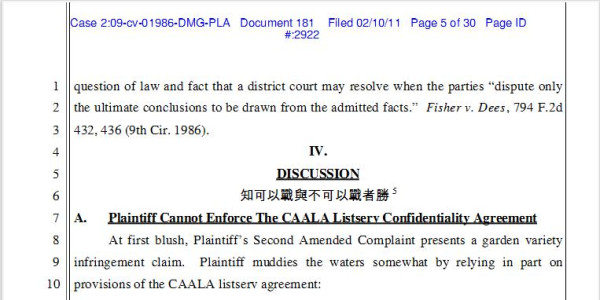
How about references to the quotations of historical figures which have withstood the test of time (in this case Sun Tzu)?
The judge referenced in the Globe and Mail article changed his writing style to be "more accessible." Here's an example:
And in a murder case last year, R v Simon, Judge Watt commenced: "Handguns and drug deals are frequent companions, but not good friends. Rip-offs happen. Shootings do too. Caveat emptor. Caveat venditor. People get hurt. People get killed. Sometimes, the buyer. Other times, the seller. That happened here."The article includes a few other examples as well.
There is no requirement that judicial opinions be dry. In fact, there are many judges whose opinions are a pleasure to read because the are the opposite of dry (e.g., Judge Kozinski). (These judges would probably all make good bloggers as well I'm guessing.) Good writing also helps the author make his or her point and judges are no different. However, at a certain point, prose can be overly indulgent, and if the judge is merely writing to demonstrate how clever he or she is, this is a disservice to the litigants and the public. There's also the point (made by Prof. Tanovich, a law clerk for former Supreme Court of Canada Chief Justice Antonio Lamer) that an opinion that is sarcastic or glib can "sensationalize and desensitize" tragic events that are the subject of opinions.
The article does not mention pop culture references but these are particularly problematic. These are the worst form of indulgences in court opinions. The judge is obviously citing the reference to show that he or she is "hip" or "with it." Pop culture references mean different things to different people, and are surely lost on people who aren't tuned in to pop culture. (Last year someone cited in a blog post to a Texas Supreme Court opinion which referenced Star Trek II: The Wrath of Khan. It was cute, and received attention in certain circles, but what if the litigants were not treekkies?) An opinion containing pop culture reference will also not stand the test of time. Justin Bieber may be popular now, but he may turn out to be unknown hundred years from now, and if you drop a reference to him in your opinion, people who are reading a hundred years from now may have no clue as to what you are talking about. (OK, this particular example isn't a great one, but . . .)
How about references to the quotations of historical figures which have withstood the test of time (in this case Sun Tzu)?



Comments