Why the Hand-Wringing Over the Outed Google "Skank" Blogger?
Good question...I don't know. More importantly, is it blogger, or "blogress" (or "blogess")? Ben S. calls her the "authoress," so I figure one of these variations work.
Seriously, the basic story of this thing that spiraled out of control and became a media event is that someone created a blog called "Skanks in NYC" on Google's blogger platform. Anonymously. The blog contained some nasty things about model Liskula Cohen. Ms. Cohen sued, or more accurately, sought "pre-action discovery" in New York. The author (Rosemary Port) contested the discovery, which sought the identity of the author. A judge in New York found the posts to be sufficiently nasty to allow the discovery. Next thing you know, the author (Ms. Port) says she's going to sue Google for revealing her identity. This should have been dismissed out of hand as mere ranting, but instead brought about a flurry of reports which actually speculated as to the merits of the author's claims. As Ben Sheffner notes at his blog here, those claims have little or no chance of success.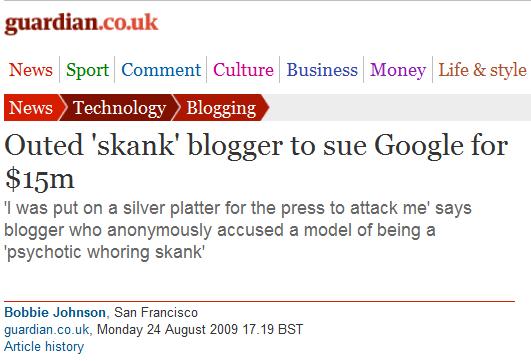
So back to basics for a moment on the anonymous blogging front. You have the right to make your views known anonymously, such as through leafletting. Courts quickly concluded that this extends to the internet as well (Doe v. 2TheMart). The right to post anonymously is not absolute, and if the person seeking your identity makes a sufficient showing, you will be unmasked. There are lots of procedural niceties and technicalities around how this works, but the bottom line (in common sense terms) is that if what you say is nasty enough (and not protected speech) don't expect to remain anonymous. There's also the matter that you may not - technically speaking - be as anonymous as you think you are.
So how did this play out in this case? Exactly as it should have. The person seeking the information was forced to make some sort of showing as to the viability of the underlying claims, the anonymous author (or authoress) was given the opportunity to defend herself and resist the outing, and ultimately, the court concluded that unmasking was appropriate. Dan Gillmor makes this point at Citizen Media Law Project here.
On the flip side, privacy expert Dan Solove thinks that additional procedural requirements (and a higher bar) are appropriate. I'm not sure forcing a person seeking a poster's identity to jump through the summary judgment hoops makes any sense, but I don't think this would have really changed anything in this case. And that's ultimately what we should take away from this episode. If you post stuff that's sufficiently nasty, you are likely to be unmasked. As with everything else in the law, the "reasonableness" standard is the anchor, and Ms. Port comes across as hopelessly unmoored from this standard.
A strange post-script to this story is that Ms. Cohen and Ms. Port are actually acquaintances, and after learning the identity of the poster Ms. Cohen decided to take the high road and not pursue any claims. Strange.
Seriously, the basic story of this thing that spiraled out of control and became a media event is that someone created a blog called "Skanks in NYC" on Google's blogger platform. Anonymously. The blog contained some nasty things about model Liskula Cohen. Ms. Cohen sued, or more accurately, sought "pre-action discovery" in New York. The author (Rosemary Port) contested the discovery, which sought the identity of the author. A judge in New York found the posts to be sufficiently nasty to allow the discovery. Next thing you know, the author (Ms. Port) says she's going to sue Google for revealing her identity. This should have been dismissed out of hand as mere ranting, but instead brought about a flurry of reports which actually speculated as to the merits of the author's claims. As Ben Sheffner notes at his blog here, those claims have little or no chance of success.
So back to basics for a moment on the anonymous blogging front. You have the right to make your views known anonymously, such as through leafletting. Courts quickly concluded that this extends to the internet as well (Doe v. 2TheMart). The right to post anonymously is not absolute, and if the person seeking your identity makes a sufficient showing, you will be unmasked. There are lots of procedural niceties and technicalities around how this works, but the bottom line (in common sense terms) is that if what you say is nasty enough (and not protected speech) don't expect to remain anonymous. There's also the matter that you may not - technically speaking - be as anonymous as you think you are.
So how did this play out in this case? Exactly as it should have. The person seeking the information was forced to make some sort of showing as to the viability of the underlying claims, the anonymous author (or authoress) was given the opportunity to defend herself and resist the outing, and ultimately, the court concluded that unmasking was appropriate. Dan Gillmor makes this point at Citizen Media Law Project here.
On the flip side, privacy expert Dan Solove thinks that additional procedural requirements (and a higher bar) are appropriate. I'm not sure forcing a person seeking a poster's identity to jump through the summary judgment hoops makes any sense, but I don't think this would have really changed anything in this case. And that's ultimately what we should take away from this episode. If you post stuff that's sufficiently nasty, you are likely to be unmasked. As with everything else in the law, the "reasonableness" standard is the anchor, and Ms. Port comes across as hopelessly unmoored from this standard.
A strange post-script to this story is that Ms. Cohen and Ms. Port are actually acquaintances, and after learning the identity of the poster Ms. Cohen decided to take the high road and not pursue any claims. Strange.



Comments