Punctuation Wars
One grammar rule that has plagued me forever is whether to put the punctuation inside quotation marks when you quote a single word (or even a two word phrase). I follow the American rule on punctuation - i.e., put punctuation inside quotation marks, but this has always looked awkward when you are just quoting a single word.
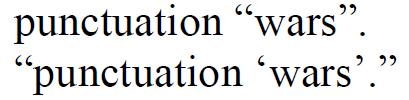
Scott Greenfield posted about this a couple of weeks back: "Bleg: End The Comma War (Update)." [It also feels awkward to put the period inside the quote here, since the period is not part of the original punctuation and was added by me, but that's neither here nor there. Also, the punctuation that always throws me off is not the comma, which rightly or wrongly I always put inside the quote, but the period. What throws me off even worse is the question mark which is not part of the original quote. The question mark inside the quote seems particularly awkward.]
Some highlights:
On a loosely related note, many people have recommended "Typography for Lawyers," which receives a mention in the comments. A worthwhile and useful looking project in my opinion. I wish someone would come up with a "use of headings" website. Headings are the unsung heroes and heroines of legal writing, and often underutilized.
Scott Greenfield posted about this a couple of weeks back: "Bleg: End The Comma War (Update)." [It also feels awkward to put the period inside the quote here, since the period is not part of the original punctuation and was added by me, but that's neither here nor there. Also, the punctuation that always throws me off is not the comma, which rightly or wrongly I always put inside the quote, but the period. What throws me off even worse is the question mark which is not part of the original quote. The question mark inside the quote seems particularly awkward.]
Some highlights:
- Max Kennerly advises us to look to what courts do and follow their convention.
- Mark Bennett suggests a different rule for single quotes than for double quotes.
- Marilou: putting the period outside the quotes is like "running around with a malfunctioning zipper."
On a loosely related note, many people have recommended "Typography for Lawyers," which receives a mention in the comments. A worthwhile and useful looking project in my opinion. I wish someone would come up with a "use of headings" website. Headings are the unsung heroes and heroines of legal writing, and often underutilized.



Venkat,
I'm not going to get into the punctuation debate, but I will say that you'll be happy to know that Butterick addresses both structural and typographic problems in his forthcoming book. It's a terrific resource, and I think you'll find it helpful, especially when used in conjunction with Bryan Garner's Modern American Usage and Dictionary of Modern Legal Usage.
Reply to this