Tony La Russa's Legal Claims Against Twitter Look Tenuous
It was bound to happen of course - someone sued Twitter for not verifying a "celebrity" or brand account. (h/t Lance Godard) Mashable reports on a lawsuit brought by Tony La Russa, who (?) is apparently a manager for the St. Louis Cardinals baseball team. (Maybe he's famous in baseball circles or something - I'm not a big sports fan so I'm out of the loop on this one.)
[Update: Mashable reports that La Russa and Twitter have resolved this one. Lesson for Twitter? Respond to squatting complaints, and get yourself a standardized complaint procedure!]
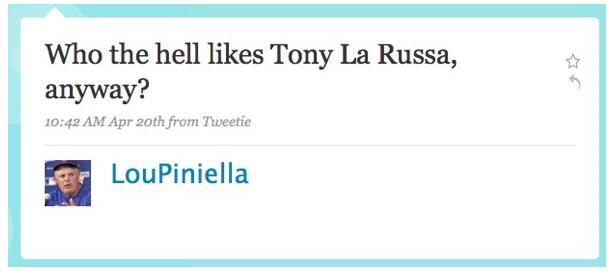 The complaint [link] contains causes of action for: (1) trademark infringement/false designation of origin, (2) cybersquatting/ACPA violations, and (3) emotional/privacy torts. Mr. La Russa's lawsuit is pretty weak for several reasons. These reasons aside, practically speaking, Mr. La Russa comes off looking fairly thin-skinned. Did he ever just ask Twitter - like the scores of other people who have had their Twitter accounts "jacked" - to remove the account or transfer it to him? (I've done this several times on behalf of clients, and Twitter has been responsive every time.)
And then there's the fact - as pointed out by Mashable - that the obviously fake Mr. La Russa profile only has 4 followers.
So, quick/off-the-cuff thoughts on the claims.
Intermediary Liability is Tough: Twitter allows you to register accounts and transmit content and links. It's a classic intermediary. Section 230 aside (which has exceptions, including trademark and state IP-based claims) it's never ever easy to hold an intermediary liable. That's true in a trademark case as in any other case. (See, e.g., Tiffany v. eBay.)
La Russa's Trademark Claims Are Weak: Surnames (names of people) typically are not entitled to trademark protection. The Complaint does not allege a registration, and it's unlikely La Russa would be able to obtain a registration for his name. A quick search of the PTO database shows one mark for "Tony La Russa Baseball" and the mark (now dead) was filed by Stormfront Studios. La Russa provided his consent apparently to this filing. It doesn't look like the fake Mr. La Russa was selling any products or services, so there's no typical consumer confusion-based claim. I doubt Mr. La Russa can make a colorable dilution claim.
Does the ACPA Apply to Twitter Accounts? La Russa's cybersquatting claims are based in part on a federal statute, commonly known as the ACPA. It prohibits cybersquatting, and has a provision that protects individuals whose names have been incorporated into domain names, but the "personal name" protection is fairly limited (it's a bit tougher to prove bad faith). The bigger question is whether the ACPA applies at all to things like Twitter accounts. I haven't seen this issue come up, but logically the answer has to be no - it does not apply. Among other things, the structure of the ACPA itself and its references to registrars, in rem actions, etc. point to the fact that Congress only intended the ACPA to apply to domain names. (Again, the ACPA may have a definition, or an easy answer to this one, I've just never seen this come up.)
La Russa's Personality Rights Claims: I'm thinking La Russa's other claims may not be preempted by Section 230 (see Prof. Goldman post) but suffer from the same general problems above. (Some of the claims may be preempted.) Also, the account obviously stated that it was a parody account, so La Russa doesn't look reasonable arguing that people were really fooled. The complaint focuses on the message Twitter transmits "Tony La Russa is using Twitter!" when you punch in his name after Twitter.com. This is obviously not going to carry the day.
Fair Use: An obvious fair use argument to be made here.
Other Points:
Added: Citizen Media notes that La Russa's lawyer tried to contact Twitter but got "no response". Anecdotal evidence points in the direction of Twitter not being very diligent about responding 100% of the time. Twitter should change this, and should really have a standardized procedure. Just templatize it and make it all online. Also, La Russa does not look as unreasonable for elevating the issue.
[Update: Mashable reports that La Russa and Twitter have resolved this one. Lesson for Twitter? Respond to squatting complaints, and get yourself a standardized complaint procedure!]
And then there's the fact - as pointed out by Mashable - that the obviously fake Mr. La Russa profile only has 4 followers.
So, quick/off-the-cuff thoughts on the claims.
Intermediary Liability is Tough: Twitter allows you to register accounts and transmit content and links. It's a classic intermediary. Section 230 aside (which has exceptions, including trademark and state IP-based claims) it's never ever easy to hold an intermediary liable. That's true in a trademark case as in any other case. (See, e.g., Tiffany v. eBay.)
La Russa's Trademark Claims Are Weak: Surnames (names of people) typically are not entitled to trademark protection. The Complaint does not allege a registration, and it's unlikely La Russa would be able to obtain a registration for his name. A quick search of the PTO database shows one mark for "Tony La Russa Baseball" and the mark (now dead) was filed by Stormfront Studios. La Russa provided his consent apparently to this filing. It doesn't look like the fake Mr. La Russa was selling any products or services, so there's no typical consumer confusion-based claim. I doubt Mr. La Russa can make a colorable dilution claim.
Does the ACPA Apply to Twitter Accounts? La Russa's cybersquatting claims are based in part on a federal statute, commonly known as the ACPA. It prohibits cybersquatting, and has a provision that protects individuals whose names have been incorporated into domain names, but the "personal name" protection is fairly limited (it's a bit tougher to prove bad faith). The bigger question is whether the ACPA applies at all to things like Twitter accounts. I haven't seen this issue come up, but logically the answer has to be no - it does not apply. Among other things, the structure of the ACPA itself and its references to registrars, in rem actions, etc. point to the fact that Congress only intended the ACPA to apply to domain names. (Again, the ACPA may have a definition, or an easy answer to this one, I've just never seen this come up.)
La Russa's Personality Rights Claims: I'm thinking La Russa's other claims may not be preempted by Section 230 (see Prof. Goldman post) but suffer from the same general problems above. (Some of the claims may be preempted.) Also, the account obviously stated that it was a parody account, so La Russa doesn't look reasonable arguing that people were really fooled. The complaint focuses on the message Twitter transmits "Tony La Russa is using Twitter!" when you punch in his name after Twitter.com. This is obviously not going to carry the day.
Fair Use: An obvious fair use argument to be made here.
Other Points:
Bottom line: La Russa's claims are fairly tenuous, and his damage claims seem weak. If he wants to spend a bunch of money and subject himself to painful discovery around what his "emotional distress" damages are all about he should go right ahead. Otherwise, since the account has already been taken down, he should just move on.
- Twitter should get a VeRO-like policy. Basically, it should formalize its takedown mechanism for fake/jacked accounts. The court in the eBay/Tiffany case liked eBay's VeRO-program, which is basically a non-statutory notice/takedown procedure. (Copyright has the DMCA procedure, this would basically mimic that, but with respect to non-copyright claims.)
- I can't figure out if the complaint pled around Section 230 or if that was just happenstance.
- I'm very curious about what happens next procedurally. Twitter likely wants to remove this to federal court, but I'm not sure off-hand how it goes about doing this.
Added: Citizen Media notes that La Russa's lawyer tried to contact Twitter but got "no response". Anecdotal evidence points in the direction of Twitter not being very diligent about responding 100% of the time. Twitter should change this, and should really have a standardized procedure. Just templatize it and make it all online. Also, La Russa does not look as unreasonable for elevating the issue.



Personal names are protected by 15 USC 1129. However, both 1125(d) and 1129 only cover domain names, not anything to the left of the domain name (subdomains) nor to the right (webfolders) which essentially constitute a URL. Domain names are defined as "any alphanumeric designation which is registered with or assigned by any domain name registrar, domain name registry, or other domain name registration authority as part of an electronic address on the Internet."
Reply to this
Great analysis on the complaint.
It's a shame La Russa didn't but his FSU law degree to better use. My favorite part is the claim that the statements are impliedly written by Plaintiff himself.” Seems to me that explicitly stating they are parodies makes it hard for them to impliedly be true.
As far as Twitter failing to take down the account. I find it a little hard to believe Twitter didn't respond and La Russa's attorneys didn't feel that was worthy of putting in the complaint. Sounds to me like it was a half hearted attempt at best otherwise it would have been in there.
Wonder if La Russa/his attorney is happy this was ever filed.
Reply to this
Thanks for a well written and well reasoned analysis. This piece seems to lay out all of the issues and supports the conclusion that LaRussa probably doesn't get too far with his case. Publicity, on the other hand.....
Reply to this
Thanks for your comments all - I'm guessing this will settle, with Twitter paying La Russa a little something for his attorney's fees (and I read somewhere maybe making a contribution to LaRussa's charity?).
Interesting either way.
Reply to this